

Monsters, Miracles, and Mythology
Exploring religion as a cultural mythology

I have recently started watching the TV show ‘Vikings’. Although I am sure it has historical inaccuracies here and there, it paints a very interesting picture of Viking culture that is actually based on primary sources. What is most interesting to me is how Norse religion functioned within this culture, and how it differs to medieval Christianity. This relationship is embodied through the character of Athelstan, a Catholic monk who is captured by the main character, Ragnar, and taken as a slave. Throughout the first season, we see the two men grow in curiosity about the other’s religious tradition, asking questions, and raising objections.
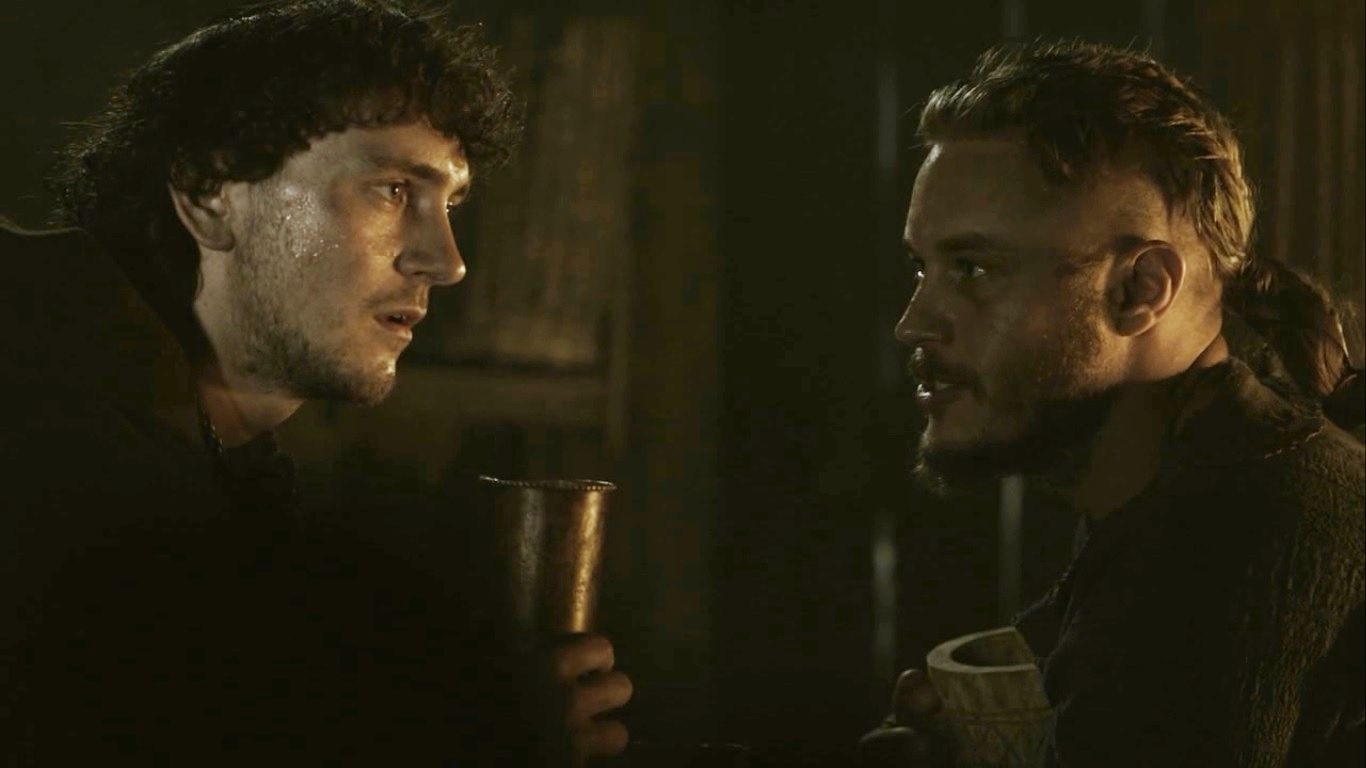
Athelstan is consistently confronted with the brutality of Norse culture, and expresses his disgust towards the slavery, warmongering, and ritual killings which are so normalised. Ragnar on the other hand, expresses confusion regarding the figure of Christ, who he sees as a weak god. He doesn’t understand why Christians are worshipping a dead god, and constantly seeks to exploit the mercy of Christians for his own gain.
For the Vikings, their cultural practices are intimately linked with their religious beliefs. Easily the most prominent example is the belief that warriors killed in battle will be taken to Vahalla by Odin to feast with the gods. This leads them to be absolutely fearless in battle, and in some cases actively put themselves in harm’s way in an attempt to die in glory.
Additionally, their belief that their fates were determined by the gods, imbues in them a sort of peace with their own situation, not worrying about what is beyond their control. Famously, Vikings wore very little armour for this reason. Armour would not save them from the will of the gods, it would just make it harder to kill others! All of this goes to show how much one’s culture is shaped by religion, and vice versa.
It’s not just paganism that this applies to though. Take St Augustine of Hippo, possibly the greatest Western Christian theologian of all time (next to Aquinas). He did not speak Greek. His theological worldview therefore was very much shaped by the prevailing North African culture and the Latin language. The way he conceptualised doctrines like original sin, predestination, the Trinity, grace, etc; all differed slightly from his Eastern counterparts. Differing interpretations of his words contributed to many of the divisions we see in Christendom today. This is all the result of something so accidental as what languages he happened to speak and not speak.
His theology is so influential in the Western Christian tradition that in the pre-Aquinas Catholic Church, to be a traditional theologian was to be an Augustinian (now it's to be a Thomist). Similarly, all of the reformers cited Augustine more than any other church father. On the other hand, in the Eastern Christian tradition, Augustine's ideas are entirely absent and eventually came to be despised (rightly or wrongly). Many Orthodox people today would give Augustine the title of "father of all Western errors". Greek Christian thought simply solidified in a different way. Why? Because of culture and language.1 So what does this tell us about religion? Well before I answer that, we’ve got to talk about ghosts and bigfoot. What a segue!
Monsters
What are monsters? Every culture throughout history has had them. Millions of people have stories about their experiences with ghosts, bigfoot, Nessie, UFOs, etc. But do these monsters actually exist? Well, yes and no. Monsters seem to come from real phenomenological experiences. I absolutely do not deny that people have actually experienced things that they take to be the supernatural. But what is actually happening here? Are people actually encountering bigfoot or aliens?
Well, probably not. In my opinion, monsters basically represent the unknown. The experiences that exist on the edge, in the periphery of human awareness, seem to fall into this category. You hear a bump in the night, and you think its a ghost. You see moving lights in the night sky, and you think its a UFO. You hear a howling in the forest, and think its bigfoot. This is essentially to say that the human brain cannot interpret experiences outside of a broader narrative. The “supernatural” is basically whatever we cannot explain. But the human tendency is to always attempt to understand the ineffable. Hence, monsters.
What is most curious about these monsters is that they begin to take on mythological proportions within particular cultures. For example, ghosts have become somewhat of a phenomenon within Western cultures in particular. Ghost hunting and ouiji boards are common activities in today’s world, and we even now have technology specifically designed for communicating with dead spirits. Who said magic doesn’t exist hey?
More than this though, we seemed to have built an entire narrative ontology for ghosts. The fact that they are dead people from bygone eras, who have experienced some sort of trauma that attaches them to a particular place. The idea that if we help resolve that trauma they can pass on to the next life. The concept of negative and positive energies that flow through spaces, or that take the form of dark non-human entities. All of this is mythology. It’s no different to what one reads in the Bible or any other religious text. Sometimes however, these monsters don’t appear as monsters at all, but as religious miracles.
Miracles
Most people don’t convert to a religion because they are convinced of an argument. Some do, but not most. Most people do so because of some sort of spiritual experience or miraculous event. By definition, these experiences are things that are outside of the realm of everyday life, and have an ineffable character to them. There is a problem with this however; the problem of interpretation. Someone raised in a Christian background is likely going to interpret an experience one way, someone raised in a Muslim background another way, and someone raised in a Buddhist background another. Let’s look at a case study.
On the 13th of October 1917, thousands of people gathered in Cova da Iria, Fatima, to witness a miracle that was allegedly promised by the virgin Mary. In the year leading up to this, three local children had claimed to witness several Marian apparitions, during which Mary made several exhortations, and also promised to perform a public miracle, so that everyone would believe them. On that day, something happened. Thousands of people claimed to have a spiritual experience.
According to many present, after heavy rain, the clouds parted revealing the sun which appeared opaque and duller than usual. It then started spinning and danced across the sky before careening towards earth at high speed, and then zig-zagging back to its normal position. Some only claimed to see bright colours. Some saw nothing. It seems though, that the prophecy came true.
In fact, there is a whole tradition of Marian apparitions in the Catholic Church. Many of them, including Fatima, include reference to distinctly Catholic doctrines like the ‘immaculate conception’. What’s curious though is how few of these apparitions happen outside the bounds of Catholicism. It turns out that most people claim to have spiritual experiences that already fit within their own religious system or cultural mythology.
As another example, Sangharakshita, a popular but controversial figure within Western Buddhism, reported seeing ‘hungry ghosts’ after meditating one day. For those of you who aren’t familiar with Buddhism, the hungry ghosts are a reference to one of the realms of existence within Buddhist cosmology. Those who are reborn as hungry ghosts do so because they are driven by intense emotional needs in an animalistic way. In this realm, these beings try to eat food and drink water but everything turns to knives or fire and ultimately harms them.
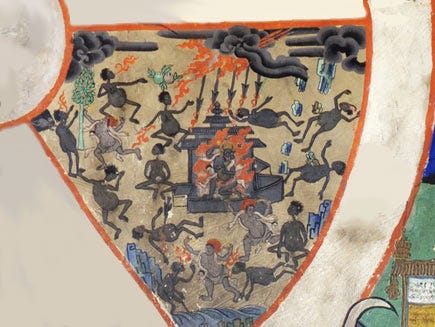
This idea is a distinctly Eastern religious one that is firmly embedded within a religious cosmology. The fact that Sangharakshita claimed to actually meet these mythological ghosts, confirms either the truth of Buddhism, or the fact that people will interpret their spiritual experiences through the lens of their religion.
Conclusion
All of these seemingly disparate phenomena all seem to point to one thing; humans are story tellers. We can’t help but experience and interpret the world through narrative. Especially when we encounter things on the fringe of experience, things we do not understand, we always, without fail, extrapolate these into larger mythologies. It is at least possible, that all of religion is a result of this process. Religion is potentially just cultural mythology on a much grander scale. Maybe God is the ultimate monster.
If you are inclined to support me financially, you can become a paid subscriber, or alternatively, you can click the button below to make a one-time donation at ‘Buy Me A Coffee’ (although as a Brit, I prefer tea). Thank you in advance!
This sheds doubt on the idea that the Holy Spirit guides the church into all truth. If that were the case, we might expect more uniformity regardless of cultural differences.
I think the number one reason why their is no consensus on who God is and why their are so many different religions and mythologies is because of human beings being fallen in their nature.
I know that you may not believe that anymore, but that is the best explanation. I believe that our falleness is what keeps us from seeing God clearly , it is like we are spiritually separated from God while in these bodies.
Our falleness affects how we perceive or view God, and plus we all have different personalities. So Religious doctrine is the way human beings try to make sense of God in our our FINITENESS.
You ask why does God not just make it clear to everyone, well i don't know why, ( I know you stuggle with the divine hiddeness of God)
I think that we fail to see that we are subject to God, not God subject to us, he is the creator, he gave us life, he does NOT owe us an explanation for why he does or does not do or allow things. ( i know that is hard pill to swallow) it was for me too.
I think it is failure to see ourselves as creatures and God as a King.
Or just imagine a pet of ours, when we take them to the vet, they do not know what is going on, they are scared, but we take them anyway for their own good.
God is beyond our comprehension and we are like small little worms trying to understand his cosmic design. Try to explain to a worm our cars or computers?
I know that may not satisfy you or you may say that it is unfair that God does not owe an explanation for his cosmic plan, and i understand where you are coming from.
I just have moved beyond that and accept in humility that i am the creature and he is the creator, and he does no owe me explanation, after all we did not create ourselves.
That is my 2 cents
I have been reading some of your postings and their are very thought provoking. I like you have stuggled with my Christian faith too for the same reasons you do.
I know its going to sound very simplistic but i do sometimes doubt that the God of the bible exists at times, but one thing that always brings me back is simply one thing?
Why do we wear clothes and why are we ashamed of our nakedness?
I have found no explanation for this in materialism or in any other religion or philosophy, only in Genesis.
If we evolved like the other animals on this earth, why are we ashamed of our nakedness? Their is no good explanation except in Genesis where Adam was ashamed of his nakedness before God?
I have not read any other philosophical explanation of this apart from God.
I know it may sound strange, but this one thing which nobody can give a good answer for keeps me believing in the God of the bible when i find myself struggling with my faith.
I think though that their is more to God then what is in the bible and what is taught in church , i think God is alot more mysterious then most theologies allow for.
I won't get into that right now, but i have also struggled with my faith and even almost embraced buddism for a while, but I keep coming back to the God of Christianity and believe that he DOES exist.
I believe God just cannot be grasped by our finite minds and his ways our mysterious. Their are certain things about the Christian Religion that i question, but i do believe God exists and that he is good, but we are not able to grasp him and his ways, it is beyond us.